Photo Courtesy of UNLV Special Collections and Archives.
Built in 1954 and opening on May 24, 1955, the Moulin Rouge was the first racially integrated hotel-casino not only in Las Vegas, but in the United States. Being the first of its kind, the property paved the way for integration in the city. With the address of 900 W. Bonanza Road, it was located on the Historic Westside of Las Vegas. The Moulin Rouge quickly became a national sensation and rivaled the success of the properties on the Las Vegas Strip.
The property was owned by three white men that saw the need for a hotel-casino that served African Americans. The men recognized the need as an opportunity to make money, so they dipped their toes into a market that no other resort was willing to get into.

Dancers perform at the opening night show at the Moulin Rouge. Photo Courtesy of UNLV Special Collections and Archives.
Not only could African Americans go to the Moulin Rouge as patrons alongside others, but the hotel-casino offered high-level jobs that were not available to African Americans in hotel-casinos. The Moulin Rouge finally gave African Americans the opportunity to work in visible, well-paying jobs such as dealers, cocktail servers, bartenders, security guards and managers. Up until this point, these people could only work back of house jobs in the rest of town. Even famous Black performers on the Strip such as Nat King Cole and Sammy Davis Junior had to enter and leave the hotel after they were done performing through the backdoor. They could not eat, drink, gamble, or stay at the hotels in which they performed. The Moulin Rouge finally was a spot that they were welcome to do it all.
Just as quickly as the Moulin Rouge opened and rose to fame, it closed just five and a half months later despite being so successful. It would later reopen under different management, but it was never the same.
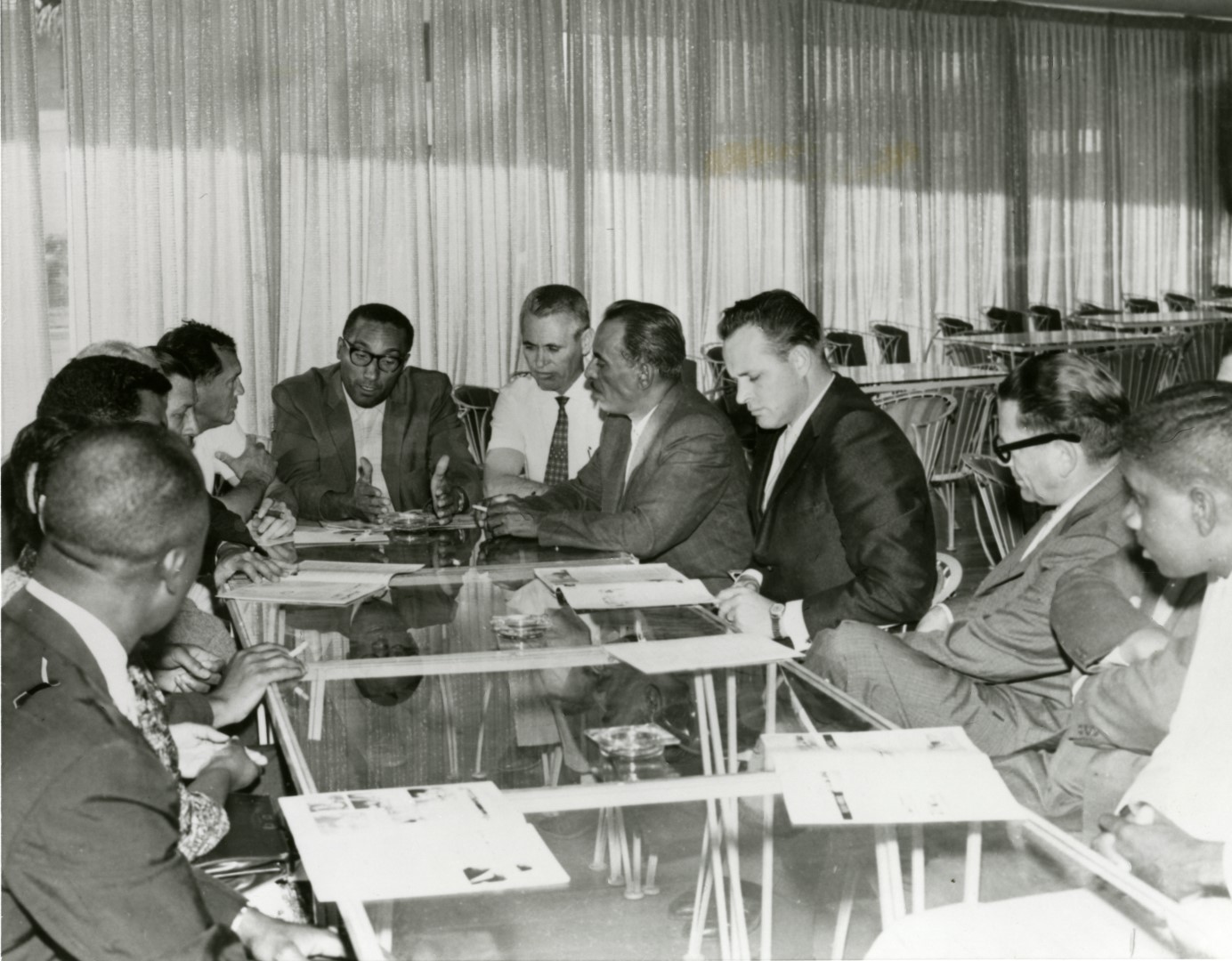
Elected officials and African American community leaders meet to desegregate Las Vegas. Photo Courtesy of the Marie and James B. McMillan Photograph Collection, UNLV University Libraries.
The Moulin Rouge played a crucial role in the desegregation of Las Vegas. On March 26, 1960, the Governor of the State and elected officials from the city of Las Vegas met with African American community leaders, the NAACP and others at the Moulin Rouge to work out the desegregation agreement to integrate Las Vegas. What came of that meeting was the Moulin Rouge agreement which allowed for the integration of public accommodations, so that African Americans had access to dining, gaming and shows, but not front-of house jobs at Strip casinos.
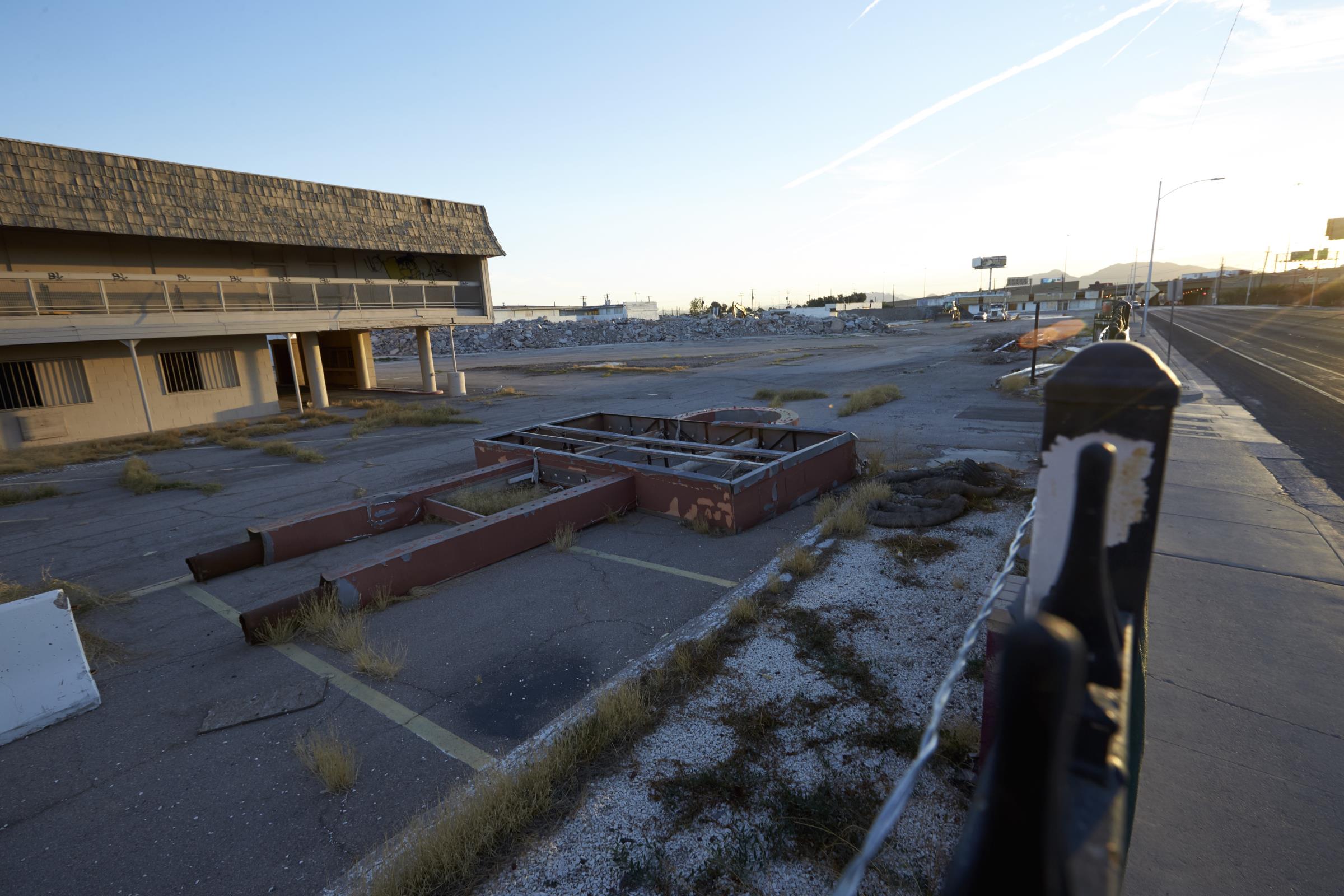
Moulin Rouge photographed in 2016 prior to the 2017 fires that completely destroyed the buildings. Photo Courtesy of UNLV Special Collections and Archives
Over the decades, the property changed over management and closed and reopened several times. Renovation plans were made, but never came to fruition. In 2003, the first of several fires to plague the property over the years gutted the complex. In 2010 the famous front facade and iconic tower of the Moulin Rouge were demolished due to safety concerns. Multiple devastating fires hit the property again in 2017, making the buildings completely unsalvageable and forcing a complete demolition of the skeletal remains.
With its famous neon sign going to the Neon Museum for historical preservation, the Moulin Rouge sign lit up for the first time in years in September of 2020. It is currently still on display in The Neon Boneyard.
Today, only the frame of the original Moulin Rouge marquee sign still stands on the property next to the otherwise flat, vacant lot.